
The Narrative Age
Guest essay

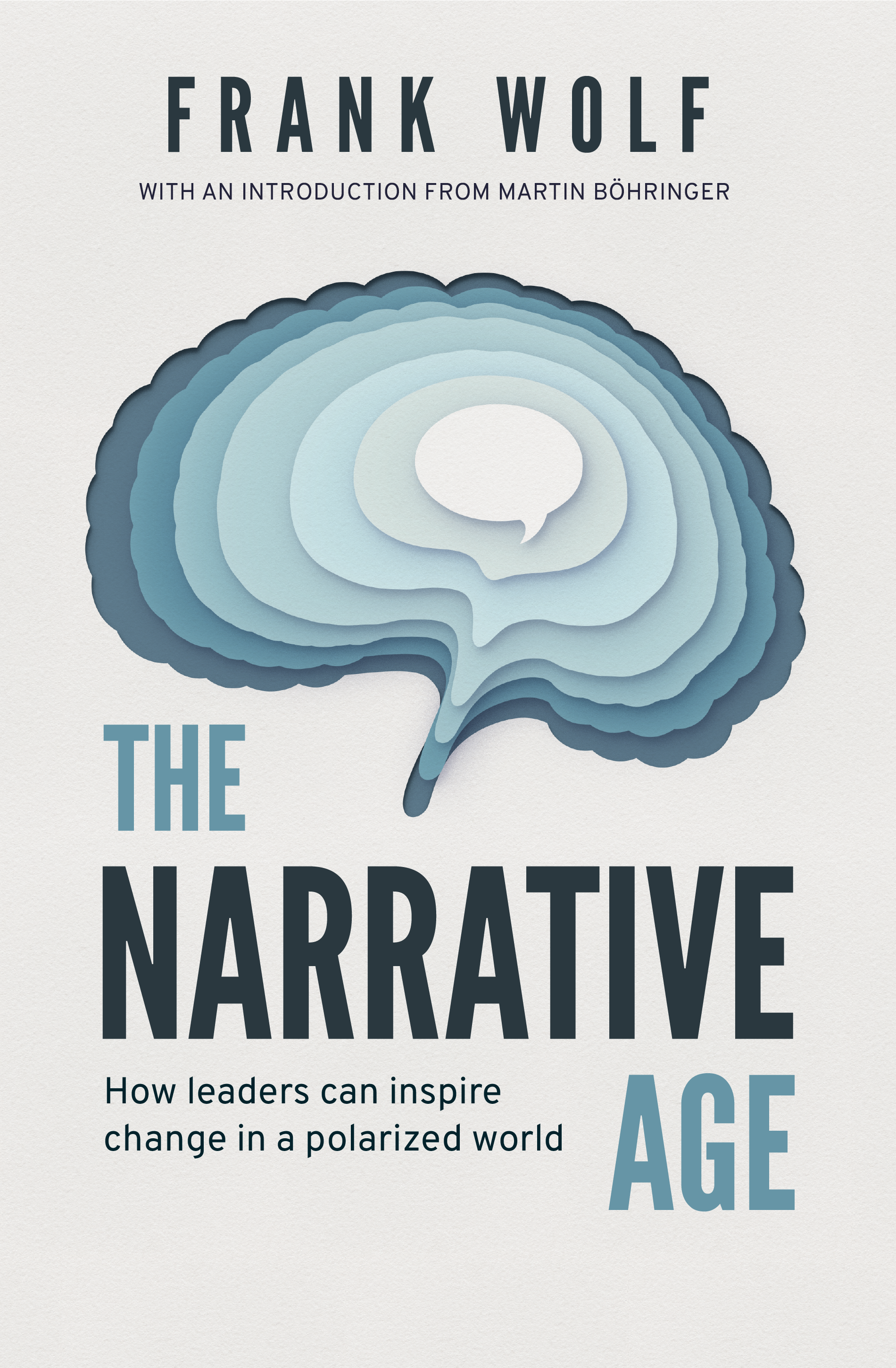
The following is an excerpt from Frank Wolf’s The Narrative Age: How Leaders Can Inspire Change in a Polarized World (2024). Frank is the cofounder and Chief Strategy Officer of Staffbase.
The Best Vision Is a Narrative
A strong organization always has a destination — something promising and unique that attracts employees, customers, and investors. A great North Star narrative can express what the organization aspires to achieve long-term, beyond just making money. Most importantly, the North Star narrative aligns and inspires employees to make the envisioned future happen. That’s why it’s the most important narrative for an organization.
Many organizations struggle with defining a compelling vision that creates commitment and alignment among their stakeholders. There are various concepts such as vision, mission, and purpose that continue to confuse strategy teams and, ultimately, employees and stakeholders. We will untangle these terms later in this chapter and unpack how the concept of a North Star narrative can integrate all of them into a much more understandable and coherent picture of the future.
A North Star narrative about the envisioned future of an organization is especially important in highly dynamic and changing environments. Emerging organizations like SpaceX, still in its early days, needed such a narrative to create a palpable fiction about the future because initially there wasn’t much to show to investors, early employees, and customers.
A strong narrative about a future destination will also be vital for established organizations that need to change their way of doing things. Stories and the greater narratives they create are the way that we as humans conceive changes. When something changes, we can tell a story, draw people in, and make them care.
A Great North Star Makes Us Care
Space travel has been a topic of debate for decades. Its supporters see it as a way to explore the unknown, expand our horizons, and advance our technology. Those who oppose space travel see it as a waste of time, money, and resources that could be better spent on solving the issues we face here on our own planet. This polarizing issue requires whoever does go to space to provide a clear and compelling reason as to why it’s worthwhile.
SpaceX has merged its vision and mission into just one statement: Making Humanity Multiplanetary. It is an iconic vision — big and far out — but, at the same time, a very good definition of the end goal. There will hopefully be a moment many years from now when we all stare in awe at a screen in front of us as we witness the first human to ever set foot on another planet.
You may argue that space and exploration companies have an advantage in creating great vision statements, as their industry is seemingly more exciting than developing software, managing nursing homes, or manufacturing appliances. While the thought of space exploration creates spectacular images in our minds, at the core, it’s the power of the stories and the narratives behind space exploration and humanity that engages us and makes us care. Powerful strategic narratives between very similar companies can tell very different stories. Let’s compare the strategic narrative of SpaceX with that of Blue Origin, a space technologies company launched just two years before SpaceX.
Blue Origin, an aerospace manufacturer and spaceflight company, was created by Amazon founder Jeff Bezos. Blue Origin’s vision is clearly reflected in its name and its goal to move harmful industries into space in order to preserve Earth, humanity’s blue origin. Its vision statement is “For the Benefit of Earth.”
Take a moment and compare both visions: “Making Humanity Multiplanetary” vs. “For the Benefit of Earth.” How do you feel about each one? What images do they bring to your mind?
The SpaceX vision is bold and visionary, whereas the Blue Origin vision seems vague and doesn’t instantly trigger strong emotions or excitement. Why is that?
Blue Origin’s vision statement doesn’t really resemble a narrative. A narrative has a basic structure of a beginning, a middle, and an end. It takes us on a journey from our normal status quo, through a catalytic event, ultimately resulting in a new normal. Many vision statements that fail to capture our attention have blurry goals about an end state, like becoming the market leader. But the beginning of a story does something that is vitally important: it makes us care. In the words of professional storyteller and coach Kindra Hall:
A bad story has a single, defining characteristic. We don’t care. Even the flashiest of colors, the biggest of budgets, or the cutest of puppies can’t make us care. They might get our attention, but they can’t make us invest emotionally. They can’t influence and transform. Fortunately, the majority of the time the root cause of this disconnect can be traced back to a single mistake, leaving out the first part of the story. The normal.
A good story, in contrast, helps us connect by giving us a clear beginning, middle, and end. For instance, any memorable movie will introduce an identifiable character that captivates us and keeps us interested in their journey. As soon as this character gets into trouble, we start to care. We stick with the story until the end.
The SpaceX vision makes us care because we are all aware of the beginning of the story: Humans have never set foot on another planet. We landed on the moon a couple of times, but that was decades ago, and to really begin to conquer our solar system, we need to go to another planet. This is the beginning of the story. It is not specifically mentioned in the SpaceX vision, but that’s not necessary because it’s universal knowledge and part of the existing narrative landscape.
Compare that to the Blue Origin vision: what is the beginning of the story here? Is space travel being used for the first time for the benefit of Earth? There are already thousands of satellites orbiting Earth, benefitting our communications, weather data, navigation, and real-time observation. None of that is new. The Blue Origin vision isn’t just vague in terms of the goal or the end of the story. It also misses the beginning, the challenge that makes us care.
A Great North Star Fits into the Narrative Landscape
Blue Origin and SpaceX differ not just in their vision but also in their commercial approach and culture. These differences lead to a much better alignment of one of the two companies with the current and emerging narrative landscape and, as I argue, consequently to long-term competitive advantages.
Both teams aim to make space travel safer and more cost-effective by developing reusable rockets. This is a long and painstaking process. A space company needs many launches to both reduce fixed development and operations costs and to innovate and build better technology. Blue Origin has developed its New Shepard rocket as a reusable launch platform for space tourism. It can launch up to six people to the borderline between Earth’s atmosphere and outer space, where they will experience weightlessness for about 10 minutes at a price tag of about $1.25 million USD per seat.
SpaceX also offers space tourism, but their main driver for launches is Starlink, a satellite-based high-speed internet service for people living in remote and rural locations around the globe. It uses a constellation of thousands of satellites that orbit the planet much more closely than traditional satellites, which leads to lower latency and fast internet access. Starlink received global attention and well-deserved praise when it was deployed to Ukraine after Russia invaded the country in February 2022. Ukraine used it to stay connected to the internet and control their drones. However, SpaceX limited Ukraine’s ability to use Starlink for military purposes, citing its policies.
Both companies also compete for NASA and defense contracts, but SpaceX has a clear advantage as it already transports astronauts to the International Space Station. NASA also chose SpaceX to develop a lunar lander based on its Starship vehicle for the Artemis mission. Through Artemis, NASA intends to explore much more of the Moon and prepare for future astronaut missions to Mars. In May 2023, Blue Origin was awarded a contract to become the second provider for the Artemis mission. NASA’s intention behind this apparent duplication of work is to foster a competitive approach that will ideally drive innovation and lower costs.
________________
One of the other dominant master narratives when it comes to space travel is exploration. Exploration is an essential part of human nature because it reflects our curiosity, creativity, and desire to understand ourselves and our place in the universe. According to genetic and sociological research, the human drive to "get out there" may well be driven by our DNA, as well as by necessity, evolution, and logic. Humans are uniquely suited to become explorers, with a set of traits such as great mobility, extraordinary dexterity, and brains that can think imaginatively.
The SpaceX narrative of exploration and making humanity multiplanetary clearly aligns much more with this master narrative compared to the more limited “For the Benefit of Earth” vision of Blue Origin. In Elon Musk’s words: “There are only a handful of really big milestones: single-celled life, multicellular life, differentiation of plants and animals, life extending from the oceans to land, mammals, consciousness. On that scale, the next important step is obvious: making life multiplanetary.”
SpaceX also benefits greatly from the structural master narrative of redemption, which involves overcoming failures and challenges to achieve success and glory. A Netflix documentary about the company tells the story of the first three launches of their Falcon 1 rocket, which failed, and a fourth and final attempt made with the last of their funding. Thankfully, that fourth launch was a success.
Blue Origin does not connect its stories to redemption. The company was much more secretive in general about its early development and progress. Blue Origin had a major incident in 2022 when an unmanned rocket crashed back to Earth shortly after liftoff, but the capsule carrying experiments managed to parachute to safety. The unplanned but successful demonstration of the capsule rescue system can be seen as a great technological success and a big leap in safety for space travel. There are a lot of videos of the incident on the internet, however, none of them are shared or commented on by Blue Origin’s own YouTube channel. Having space tourism as a business model, it might be reasonable to want to avoid pictures of exploding rockets and failures. Still, this positioning deprives Blue Origin of a powerful way to tell stories about the challenges they are overcoming.
What’s left is the potentially most fundamental master narrative of them all — the drive for any kind of living creature to survive. Animals, humans, organizations, and societies have a deep desire to be around for another day, year, or century. Right now, we are alone in the universe, and whatever we achieve as humanity will be gone if our planet is destroyed or becomes uninhabitable. Being able to explore space could make a difference for ensuring the survival of our species. This is indeed a specific motivation for SpaceX as Musk agrees: “If we are able to go to other planets, the probable lifespan of human consciousness is going to be far greater than if we are stuck on one planet that could get hit by an asteroid or destroy its civilization.”
Overall, SpaceX achieves a significantly better fit to the master narrative landscape. Both companies have been founded by iconic entrepreneurs, and they showcase the fact that private initiative and innovation can challenge the traditional model of centralized, government-directed space activity. SpaceX forges ahead with its compelling vision and stories that connect to the powerful and deeply rooted master narratives of exploration, redemption, and survival as a species.
______________
Scientific American’s Senior Editor Clara Moskovitz wrote an article in 2022 entitled “Billionaire Space Tourism Has Become Insufferable” which argued that space travel has shifted “from brave exploration to just another playground for the 0.0000001 percent.” This issue hit a nerve especially because shortly before, in July 2021, another billionaire, Richard Branson, had also traveled to space with his company Virgin Galactic, doing so at the same time many ordinary people were exhausted with strained finances in the middle of the COVID-19 pandemic.
Blue Origin is trying to counter this challenge by telling stories about space tourists and their achievements and dreams. These stories might be personal and emotional, but it’s hard to forget the negative narrative of the excesses of the rich because the journey to space is such an incredible privilege for a tiny fraction of humanity.
SpaceX is in a much better place in the narrative landscape here. This is because its main activity does not center around tourism, but rather global internet access with the Starlink offering. Moreover, the indispensable role of the Starlink network for the defense of Ukraine has even credibly connected the activities of SpaceX to Blue Origin’s vision, “For the Benefit of Earth.” It is not the main vision of SpaceX, but for now, they have filled it with more life and actual stories compared to Blue Origin.
_______________
As an employer brand, SpaceX achieves vertical integration between master narratives, emerging narratives, and individual narratives for a specific audience: people who seek growth opportunities and who are willing to go the extra mile. The combined SpaceX narrative could be summarized like this:
There are few visions greater than making humanity multiplanetary. We do this with a culture that was born in Silicon Valley and has helped countless companies to become undisputed market leaders in their field. Working at SpaceX means growing every day and going the extra mile, but it is incredibly rewarding as you will work with world-class talent to change the future of humanity.
Considering Blue Origin’s narrative in the same light, it struggles to match the captivating levels of storytelling from SpaceX. Blue Origin struggles to connect positively to the existing narrative landscape with its vision. It is still a very attractive employer, especially considering the employees’ much better work/life balance, but SpaceX might be the more attractive employer overall, especially for talent with a strong growth mindset. Over the long term, this can have an influence on further extending the competitive advantage that SpaceX has today.
Blue Origin’s opportunity lies in securing contracts such as those awarded by NASA. This might provide new opportunities to better connect the vision to the narrative landscape and tell stories beyond space tourism. For example, an adapted vision from “For the Benefit of Earth” to “Exploring Space to Protect Earth” would already introduce a connection to the exploration master narrative and make clear that supporting our planet with insights and resources from space is not a nice-to-have but an essential part of the plan to allow humanity to survive and thrive on our blue origin.
Get your copy of The Narrative Age: How Leaders Can Inspire Change in a Polarized World.
Frank Wolf is the cofounder and Chief Strategy Officer of Staffbase, an employee and corporate communications platform that has inspired more than 2,200 of the world’s leading organizations. With more than 20 years in the communications field, Frank has contributed to the Forbes Communications Council and various thought leadership platforms. He lives in Dresden, Germany, with his wife and two teenage daughters.
 |
|