
Corporate Comms Isn't Always Inspiring (But You Can Find Inspiration) (Part 1)
The authority on mixternal comms

Browsing a local used book store I came across the following trove 👇.

A shelf full of comms books! But I didn’t even bother to look at the titles. I thought of you, dear readers, took the pic, and moved on to another section. Why? Because I’m not looking for inspiration within our industry. I rarely do.
Don’t tell anyone, but I’ve never read a comms book 🤫.
I seek inspiration elsewhere using orthogonal thinking. If it weren’t for this mental framework I might have burned out of comms several years ago. Being influenced by what’s happening outside of comms inspires me to higher levels within comms.
🔥 I want you to keep the flame. That’s why in this two-part series I:
Explain what orthogonal thinking is and is not
Show how orthogonal thinking inspires this newsletter and my own work
Provide ideas on how to apply orthogonal thinking to seven aspects of your work in mixternal comms:
Storytelling
Employee engagement
Stakeholder management
Technology
Unconventional communications
Disruptive communications
Operations
When you finish reading I hope you will see how a different way of thinking can inspire you to solve a vexing problem or refresh a stale campaign while lifting your personal comms game to another level.
Orthogonal Thinking

Orthogonal thinking is a thought process that involves taking ideas, concepts, or perspectives that are unrelated and applying them to your work—in this case, mixternal communications.
Orthogonal thinking requires exploring multiple unrelated dimensions or possibilities to solve a problem or generate ideas.
For example, can you apply how you organize Girl Scout outings to how you manage a content calendar? (Probably not, but it’s plausible. And it’s orthogonal.)
Analogies are not orthogonal thinking. It’s not what we can learn about authentic communication from Succession or how anything in pop culture can teach us six ways about blah blah, because really, couldn’t you do that magic trick with any pop culture reference?
What the Avengers Can Teach Us About Being a Team Player
Crisis Comms As Practiced by Taylor Swift
What Game of Thrones Can Teach Internal Comms About DEI
Boring. Easy. What?!
Problem-solving is what we’re getting at with orthogonal thinking. Understanding how Ted Lasso1 inspires greatness does nothing to solve dysfunction on your comms team.
Why engage in orthogonal thinking?
Orthogonal thinking can be valuable in problem-solving, innovation, and decision-making processes, as it allows for the exploration of unconventional or overlooked solutions.
By considering orthogonal perspectives, you can:
challenge existing assumptions, break away from traditional patterns of thought, and generate novel ideas.
expand the range of possibilities and uncover new insights and solutions by looking beyond obvious connections.
encourage creativity, flexibility, and a willingness to explore uncharted territories in order to arrive at unique and potentially innovative solutions.
develop a mindset that is open to new ideas and comfortable with uncertainty.
A classic example of orthogonal thinking: One day during a walk with his dog the Swiss engineer George de Mestral observed burrs sticking to his clothes and the dog's fur. Intrigued, he examined the burrs under a microscope and discovered tiny hooks that allowed them to attach to fabric (and fur). de Mestral then developed a fastening system inspired by what he saw. He called it Velcro.
de Mistral didn't look to the world of fasteners—glues, buttons, buckles—for inspiration. His insight came from Nature, a world unrelated to his fixation, a legendary orthogonal leap.
Related: It’s okay to steal tried and tested ideas from other sources, like Picasso, Axios, or Al Jazeera ($).

Orthogonal Thinking and Mister Editorial

I regularly review ~75 resources—newsletters, podcasts, video channels, books, journals, etc.—for Mister Editorial. I’d guess that about one-fourth of those sources have nothing to do with communications per se.
Staying on top of trends in media, news reporting, technology, philosophy, business, sociology, and other realms keeps me sharp and inspires me to explore the adjacent possible.
Orthogonal thinking has inspired much of Mister Editorial:
Innovation in Internal Communications: How Internal Communicators Can Avoid the Innovator’s Dilemma, a nine-part series and my first mini-book, made the case for innovating to breathe life into a stale comms experience. The work was inspired not by an IABC Gold Quill award-winning project or a keynote address at a comms conference, but by a 1997 classic business book.
Communications As Craftsmanship: How Comms Professionals Can Rise Above Banality, an eight-part series that resulted in my second mini-book, argued that we comms professionals should take our profession seriously and elevate our work to the level of craftsmanship. The series was inspired not by a CCO or insights from an article in PR Week, but by David Pye, a woodworker and furniture designer.
My Intellicomms series is inspired by cutting-edge advancements in artificial intelligence as practiced by artists, writers, journalists, technologists, and entrepreneurs.
An anthropologist is inspiring the deep work and research I’m doing now about the comms profession.
These bullets and bold words are inspired by Axios, a media company.
Most of the ideas I generate for Mister Editorial using orthogonal thinking don’t stick, and that’s OK! The idea is to always be closing2—trawling. I currently have 48(!) articles in various stages of completion.
Many of them are a single sentence or just a headline because I was inspired by something I randomly stumbled on while doing something outside of work and thought it might lead to something.
Take, for example, this empty draft 👇. I don’t even remember exactly where the idea came from, but I know it was a nonfiction book, perhaps Where Good Ideas Come From. I learned about W. Edwards Deming and his idea of the “System of Profound Knowledge.” Deming’s system includes four components or "lenses" through which to view the world simultaneously:
Appreciating a system
Understanding variation
Psychology
Epistemology
💭 When I came across Deming’s concept I thought, Hmm. Can we understand communications within a corporation through Deming’s lenses?
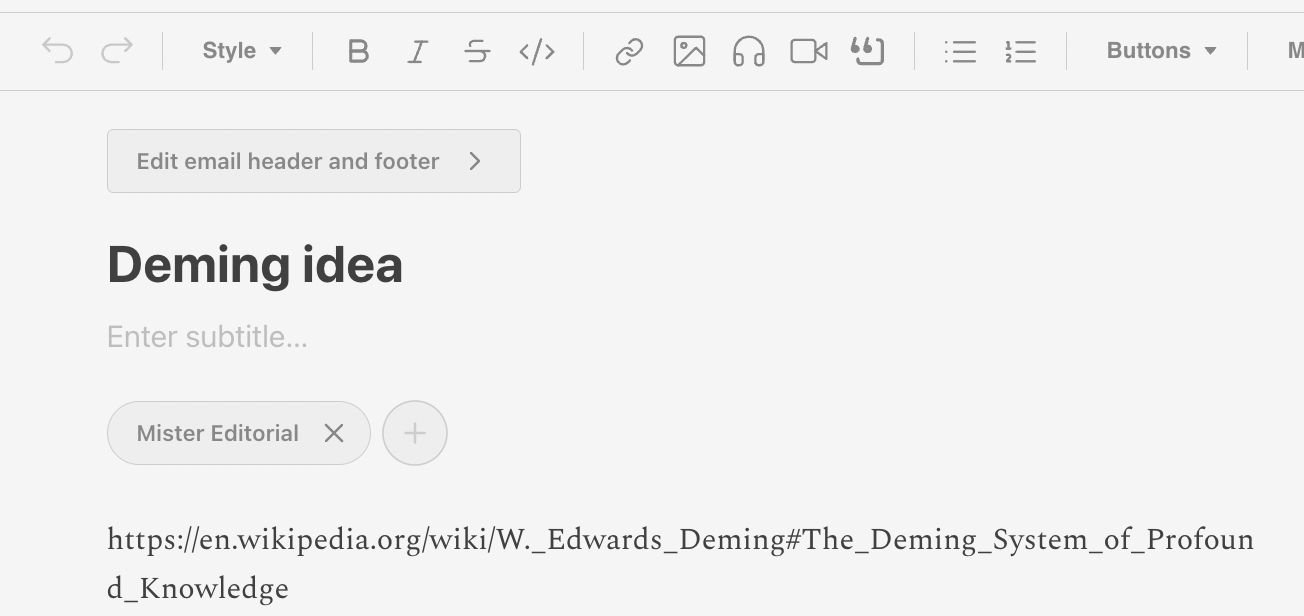
The idea has languished for more than a year.
“Innovators seek to improve capabilities by multiples. Innovation is multiplicative, not additive.”
—Ray Kurzweil, The Singularity Is Near
Orthogonal Thinking for Communications
In the rest of this two-part series I provide ideas from outside of mixternal communications to seven aspects of our work. I begin with an example for each area and then suggest another two or three prompts—inspiration—for thinking differently about the same ol’, same ol’ in your work.
Storytelling

Transmedia storytelling involves telling a story across multiple platforms and formats, such as books, movies, video games, theatre, and more. It breaks free from the traditional linear narrative structure and encourages the audience to engage with the story through various channels.
Think of the Harry Potter and Star Wars narratives, which take place across books, movies, theatrical plays, comic books, animated series, streaming TV, theme parks, video games, and more. In both examples, audiences can choose when, where, and how they want to engage with the story.
Could you apply transmedia storytelling to a company initiative? What if, for example, your company has a character—a "man of the people" or "reporter on the ground" kind of character—who appears across different channels throughout the year—town halls, YouTube videos, intranet articles, Instagram Reels—hammering on the same story (e.g., philanthropy, innovation, sustainability) across different mediums.
Employees might be delighted to encounter the ever-curious character in unexpected places. (That character would end up drawing a following and becoming an influencer.)
Three more ideas for applying orthogonal thinking to storytelling:
What if you use an unconventional character—like the sidekick, contrarian, or body part—through which to tell your story? Would your blog posts get more traction?
If professional journalists want more data to help tell their stories, shouldn’t we unofficial corporate journalists want the same?
What if for your next product launch, you told the story of how the widget came about in the style of a comic book or graphic novel? How could that inspire employees?
Employee Engagement
Word of mouth is the best form of advertising. If you sell a consumer product the loud and proud endorsement of your thingamajig is worth more than a pricey marketing campaign. Such is the secret to GoPro's success. Cameras strapped to the backs of sea turtles or to the helmets of skydivers and bike messengers share incredible perspectives once the imaginative domain of novelists and comic book artists.
With encouragement from GoPro “citizen directors” (consumers, audiences) upload and share these amazing videos on YouTube, which spreads excitement for the product, fueling sales and more video uploads, and so on. A virtuous cycle money can't buy.
Brace yourself for some crazy talk: What if you opened up your intranet and let any consumer—er, employee—post an article? Messy at first with a lot of dreck, sure, but after a while the cream would rise to the top. Employees who share relevant and helpful information and have decent writing and photography skills would gain a following, encouraging more engagement and more posts, and then, as my British readers would say, bob’s your uncle you have a virtual engagement cycle.
Read counts or upvotes (like how Reddit works) or video views (as is the case with GoPro) would separate the chaff from the wheat.
Opening up your intranet to all employees is a radical way to promote the usefulness of your intranet and to get employees involved in knowledge sharing and culture building.
Two more ideas for applying orthogonal thinking to employee engagement:
What if at your next town hall—to everyone’s surprise—senior leadership addressed comments they uncovered while lurking in Slack channels? (Kinda how celebrities read mean tweets, but without the mean stuff.) Would that encourage more employees to use those channels?
What if instead of trying to get everyone plugged into a social ambassador program you gave out awards for the best social media posts that promoted #lifeat[company]? Would that encourage more engagement with your hashtag and social channels than you’re getting with the advocacy platform your begging employees to use?
“Not respecting the boundaries between disciplines is a good algorithm. You should specialize because you have to know something. But once you specialize up to a certain point you should be looking for ways to fertilize or cross-pollinate other areas, because these are arbitrary silos people get into.”
—philosopher and neuroscientist Sam Harris
Stakeholder Management

Money is a great incentivizer. Many organizations dole out bonuses based on how the company performed that year. If the business reaches a certain revenue milestone, profits are distributed among employees. The structure is in place to motivate employees to perform their best and deliver superior returns.
Side note: Speaking of money. Here’s how you can boost your income in comms ($).
What if your department budget—and that of your stakeholders—was partly contingent on how well your comms performed? (🤯 🤯 🤯) Would that incentivize your stakeholders to provide more meaningful and precise materials and objectives?
How many times have you published content only to watch it die quietly in a black hole? Might this change the trajectory of your star pieces?
Would attention on pageviews or retweets encourage stakeholders to give you a hand and help promote and disseminate the comms?
If you missed your target metrics, would you get money deducted from your budget? Crazy talk! But such dis/incentives might prevent the weakest comms requests from being thrown at you (especially last minute).
Money for next year’s coffers would tie directly to agreed-on metrics, such as downloads, attendance, clicks, shares, votes, story placements, media pickup, etc.
Two more ideas for applying orthogonal thinking to stakeholder management:
What if you published your team’s metrics on the intranet so your stakeholders could see their content performance stats whenever they wanted? Imagine them using your data in their presentations to their bosses. On top of it being a self-service mechanism, the usage is free publicity for your work!
What if someone from the IT team was embedded in Corp Comms and reported up through comms rather than through Information Systems? Would IT be better aligned with comms’ technology needs? Would it expedite—or at least alleviate—painful tech requests, upgrades, and fixes?
Phew.
This is a lot. I’ve introduced orthogonal thinking, showed how I apply the framework to Mister Editorial, and provided several examples on how to use it for storytelling, employee engagement, and stakeholder management.
In part two I’ll discuss how you can apply orthogonal thinking to these comms areas:
Technology
Unconventional communications
Disruptive communications
Operations
Reminder: Most people don’t read/listen to/watch the same book/podcast/music/movie/TV show you’re into. Using pop culture analogies is more about you than about your audience. To wit: only 870,000 people watched the premiere of season three of Ted Lasso, 0.26% of the U.S. population. This means at your company of 10,000 employees maybe 26 employees saw the episode. (A disproportionate number of them seem to be in Comms.) So maybe tap the brakes on the too-clever pop culture references.
Most readers won’t get that reference (see above; footnote 1). But I get it. There’s a lot of pleasure in sharing deep cuts, throwbacks, winks, and nods with those who do get it. Being in the know binds us to an imagined community (meta-reference!). Just do so sparingly—a clause here, an image there. Refrain from creating entire content out of it. (Again, see above.)
Thank you for being a part of Mister Editorial.
Read past editions of Mister Editorial here. If you’re enjoying what you’re reading, please consider recommending it to others. They can sign up here.
Have feedback? Send me a note at editorshaun@gmail.com. Connect with me on LinkedIn and Twitter.
Disclaimer: Besides running Mister Editorial, I am the editor-in-chief of Digital Publications at Lam Research. The views in this newsletter are my own.
Oh, you kept scrolling…
Do you have FOMO on what’s happening at the companies you left behind? (Probably not if you’re on LinkedIn and spammed with a daily feed of “so proud to work for a company that [fill in the blank with the non-special thing that most companies do].” I digress.)
BlackRock encourages FOMO ($).
Insider Comms: Keeping Alumni in the Loop (BlackRock)

BlackRock is doing mixternal comms. The company—my former employer—regularly shares internal emails and updates with its alumni network to keep possible boomerang hires up to date on internal happenings. It’s a smart move since former employees are already familiar with company culture and need less training than fresh recruits.