

In part one of this two-part series I introduced orthogonal thinking, showed how I apply the framework to Mister Editorial, and provided several examples of how to use it for storytelling, employee engagement, and stakeholder management.

As a reminder:
Orthogonal thinking is a thought process that involves taking ideas, concepts, or perspectives that are unrelated and applying them to your work—in this case, mixternal communications.
By considering orthogonal perspectives, you can:
challenge existing assumptions, break away from traditional patterns of thought, and generate novel ideas.
expand the range of possibilities and uncover new insights and solutions by looking beyond obvious connections.
encourage creativity, flexibility, and a willingness to explore uncharted territories in order to arrive at unique and potentially innovative solutions.
develop a mindset that is open to new ideas and comfortable with uncertainty.
In part two I show how you can apply orthogonal thinking to these areas of comms:
Technology
Unconventional communications
Disruptive communications
Operations
Technology

The most radical change to the automobile industry over the past 130 years is happening now: getting rid of the driver. Autonomous driving doesn’t improve traditional vehicles; by challenging conventional thinking, self-driving cars revolutionize the concept of transportation.
The positive externalities—increased safety, efficient use of fuel, reduced traffic and congestion, and countless unknowns—remain to be seen and felt. Exciting, isn’t it?
How can you revolutionize technology used in your everyday comms experience? Could you, for example, radically change how you use Slack and Teams? The two platforms are designed for asynchronous communication—humans interacting with other humans (or bots) in a conventional manner: typing messages back and forth, sharing intel and docs, and dropping the occasional video, emoji, or gif.
What if you spun up a dozen channels and turned them into permanent Ask Me Anything forums, where employees could ask leaders (or leaders of departments) anything they wanted at any time?
Luckily I have a two-part series ($) that explains three kinds of AMAs and ways to set them up:


Two more ideas for applying orthogonal thinking to comms technology:
What if you incorporate virtual reality into your internal storytelling? ($)
What if corporate comms embraced artificial intelligence?
“Don’t bother just to be better than your contemporaries or predecessors. Try to be better than yourself.”
—William Faulkner in The Writer’s Chapbook
Unconventional Comms

“Unconventional" and "disruptive" are similar, but different.
Unconventional refers to something that deviates from the norm and accepted practices or traditions. An unconventional idea or approach may be different from what is expected but it doesn’t challenge (upend) existing systems.
Disruptive refers to something that shakes up or radically changes existing systems (or industries or markets if you’re in a market-mindset). Disruptive goes beyond being unconventional because it challenges the status quo and introduces new ways of doing things. (More on disruptive comms below.)
Let’s think unconventionally…
There are five key assets to building a brand: logo, slogan, mascot, color, and product. A report from Ipsos (market research firm) and JKR (branding business) tries to uncover what makes brands distinctive—i.e., what makes them stick out—by studying these elements. They look at well-known brands like Coca-Cola, Dunkin’, M&M’s, and Burger King, among others.
The report quotes another study that says presenting brands consistently across all platforms can increase revenues by up to 23%.
Can you translate that to comms work? Would presenting your brand across all mixternal platforms increase your team’s authority by 23% 🤷
You need to do three things if you want a distinctive brand:
Understand the essence of who you are
Know the whole is greater than the sum of its parts
Be Distinctive. Everywhere.
If you’re trying to build your internal comms brand, say around the intranet or a newsletter, could you learn something about how famous brands do it?
Three more ideas for applying orthogonal thinking to unconventional comms:
When I was in grade school, every morning someone from the principal’s office would read out the morning’s activities over the intercom—speakers attached to the walls inside every classroom—so we knew about activities happening at school that day. What if at the start of every shift on the factory floor a two-minute readout of company news came over the intercom?
What if your press releases were done only as videos posted to social media?
What if you used Twitter as an AMA platform to engage with consumers or the media?
Disruptive Comms Channels

A reminder that disruptive ideas are more significant because they fundamentally change or displace systems, processes, and tradition. Ask yourself: why am I not being disruptive? Could it be that you’ve succumbed to the IKEA effect?
The IKEA effect is a cognitive bias in which consumers place a disproportionately high value on products they partially created. The name refers to Swedish manufacturer and furniture retailer IKEA, which sells many items of furniture that require assembly.
Are you afraid of trashing your intranet, refreshing your newsletter, building a new website, or simply changing your comms strategy because you’ve spent so much time, energy, and resources on creating what you have?
Are you stressed and anxious because you know a different channel, platform, strategy, or course of action is needed and is the right thing to do, but you don’t have the stomach to speak out or admit defeat?
You cannot be disruptive if you hold onto legacy systems and processes. Here we can learn from The Innovator’s Dilemma, the classic 1997 business book by Clayton Christensen. As I discussed in my series on the topic ($):
Just as companies need consumers to buy, use, and promote their goods, comms needs employees/audiences to consume, act on, and share our communications (i.e., our goods).
And just as incumbent (established) companies are faced with choosing to stick with the status quo or investing in disruptive innovation to maintain or grow market share, comms must determine whether to stick with what’s working or invest in innovative communications to maintain or grow readers’ attention.
If we substitute comms for companies and employees/external audiences for customers, we can learn from Christensen, so we can overcome our version of the innovator’s dilemma.
Three more ideas for applying orthogonal thinking to disruptive comms:
What if instead of revamping your intranet you printed a quarterly newspaper sent to employees’ homes? That’s not only disruptive—it’s retro!
What if your next all-hands used holograms? ($)
What if you took a page out of the marketing handbook and used cash incentives to induce employee influencers to share your comms internally and externally?
“Hell, there are no rules here—we’re trying to accomplish something.”
—Thomas Edison describing how his lab worked
Operations
The critical question asked by a visionary comms team is not How well are we doing? or How can we do well? or How well do we have to perform in order to meet expectations? For visionary teams the critical question is How can we do better tomorrow than we did today?1
Visionary companies like Procter & Gamble and Marriott attained their positions largely because of a simple fact: they are terribly demanding of themselves. They embraced the concept of “continuous improvement” to a degree that it became a way of leadership and behavior from the CEO down to individual contributors.
Couldn’t you apply the same demand and pressure to your own operation as a disciplined way of being? Can your team find discontent in the status quo? What is it that you can invest in for the long-term that can make your team stronger tomorrow than it is today?
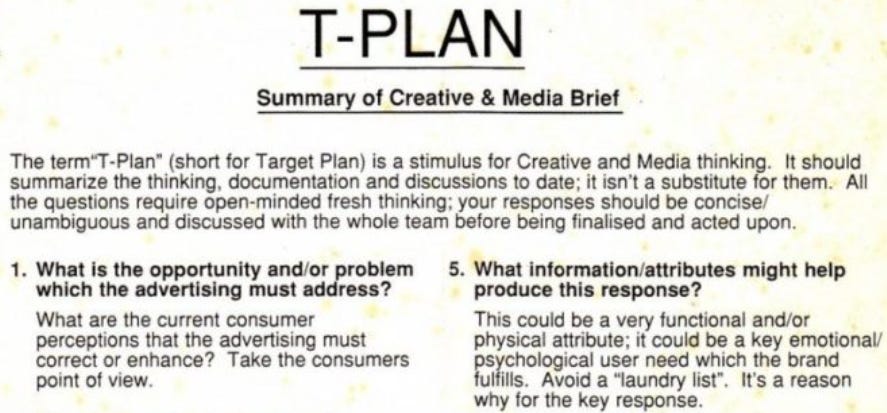
Stephen King—not that Stephen King—was an advertising guru. In 1964 he created the T-Plan (Target Plan), a set of advertising guidelines that combined market research and consumer insights to develop more creative and effective advertising.
The T-Plan asked the following questions about an ad campaign. I have substituted “comms” for “advertising,” a classic Mister Editorial orthogonal move:
What is the opportunity and/or problem that the comms must address?
What is the role of comms?
Who are we talking to?
What is the key response we want from the comms?
What information/attributes might help produce this response?
What aspect of the brand personality should the comms express?
Are there media considerations?
This could be helpful… [any additional information]
Go deeper into these questions.
King declared the T-Plan to be “an absolutely universal aid to planning anything whatsoever.” Prove him right or wrong by adapting his plan to your comms intake form!
Two more ideas for applying orthogonal thinking to your operations:
What if the Corporate Comms team adopted the scrum methodology to get work done?
What if you deleted all recurring meetings?
Conclusion

There you have it—31 ways to think orthogonally in corporate comms.
If that’s not a jumpstart I don’t know what is.
The bottom line: To incorporate orthogonal thinking into your comms work you must constantly and consistently:
Seek external inspiration: Look beyond the comms industry for inspiration. Explore how other fields operate and identify any practices or approaches that could be adapted to your work or that of your team. Roam far and wide and have as many experiences as possible. External perspective can spark new ideas and challenge existing paradigms.
Experiment and pilot new approaches: Encourage the team to experiment with new processes or tools on a small scale. This could involve implementing a new project management process, trying out different technologies and channels, or reorganizing your team or workflows. Encourage feedback and iterative improvement based on the results. Do this on team and individual levels.
Many things won’t work out. But some will. Do you and your team want to be remembered for the same ol’ or for initiating breakthroughs? I’ll leave you with this concluding provocation:
What if you thought differently about how to do mixternal communications? 🤔
Adapted from Built to Last: Successful Habits of Visionary Companies by James Collins and Jerry Porras. Published in 1997, the authors examine how great companies endure for at least 50 years. My application of their theories about corporate success to corporate comms is the kind of orthogonal thinking I do all day long, comms-rades. Collins and Porras also engage in that kind of thinking. The Faulkner quote early in this article was included at the start of chapter nine of their book. Academics reading Faulkner and thinking about business strategy? Say it with me: that’s orthogonal thinking!
Thank you for being a part of Mister Editorial.
Read past editions of Mister Editorial here. If you’re enjoying what you’re reading, please consider recommending it to others. They can sign up here.
Have feedback? Send me a note at editorshaun@gmail.com. Connect with me on LinkedIn and Twitter.
Disclaimer: Besides running Mister Editorial, I am the editor-in-chief of Digital Publications at Lam Research. The views in this newsletter are my own.
Oh, you kept scrolling…
How do you manage your storytelling workflow? Here’s how I do it:
